
Understanding AAI in Down Syndrome Fitness

Protecting the Neck: Understanding AAI in Down Syndrome Fitness
When designing fitness programs for adults with Trisomy 21 (Down syndrome), safety must always drive our exercise selection. As a Level 2/3 Personal Trainer and Level 4 Sports Nutritionist, my absolute priority is creating effective, life-changing workouts that protect our clients' unique physiology.
One of the most critical medical conditions we must account for in adaptive fitness is Atlantoaxial Instability (AAI).
Here is everything parents, carers, and fitness professionals need to know about AAI, the red flags to watch out for, and how we design our programs from the ground up to eliminate these risks.
What is Atlantoaxial Instability (AAI)?
To understand AAI, look at the top of the spine. The Atlas (C1) is the first vertebra right below the skull, and the Axis (C2) is the second vertebra that allows the head to rotate.
   [  SKULL  ]
       ││
   ┌───▼▼───┐  ◄─── Atlas (C1)
   │  (O)   │
   └───▲▲───┘  ◄─── Joint space held by ligaments
   ┌───▼▼───┐  ◄─── Axis (C2)
   │  / \   │
   └────────┘
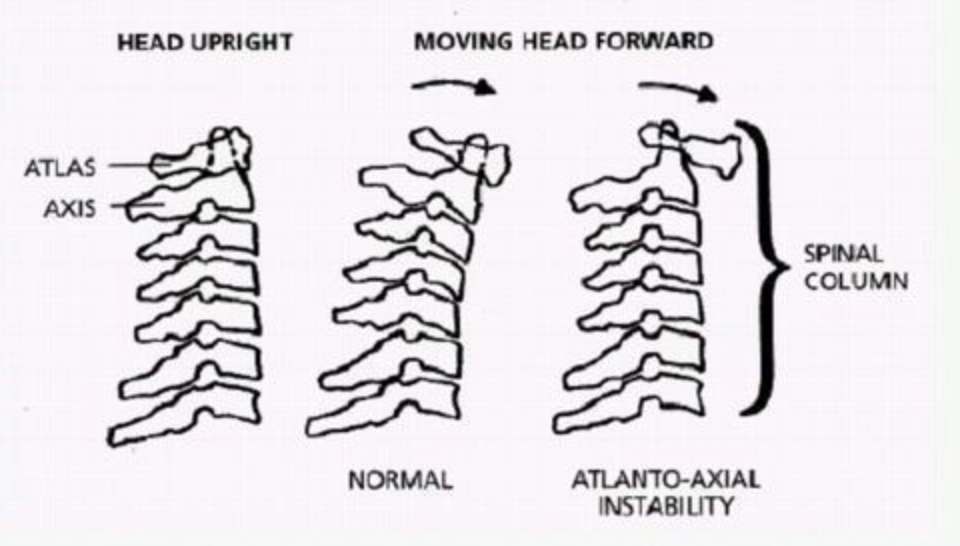
In typical anatomy, incredibly strong ligaments hold these two bones tightly together. However, a hallmark trait of Down syndrome is ligamentous laxity—meaning the ligaments throughout the body are naturally more flexible, loose, or "floppy." When the ligaments in the upper neck are too loose, the C1 and C2 vertebrae can slip out of alignment or move excessively. If they shift too much, they can compress or pinch the spinal cord, leading to permanent neurological damage.
Key Facts Every Carer Should Know
It is common but usually silent: AAI affects between 6.8% and 27% of individuals with Down syndrome. The vast majority of these individuals are asymptomatic, meaning the instability shows up on an X-ray, but they feel completely fine and have no nerve compression.
Symptomatic cases are rare but serious: Only about 1% to 2% of people with Down syndrome develop symptomatic AAI, where the bones actively press against the spinal cord.
Screening is vital: AAI is officially diagnosed using lateral cervical spine X-rays taken in different neck positions (neutral, bent forward, and bent back).
The Red Flags: Symptoms to Monitor
Because we deliver our fitness programs online worldwide, we cannot be in the room to physically spot your loved one. Therefore, it is vital that parents and support workers know the neurological "red flags."
If your young person or adult displays any of the following symptoms, stop all exercise immediately and seek an urgent medical evaluation:
Changes in Walking (Gait): Sudden clumsiness, unsteadiness, tripping, or legs randomly giving way.
New Physical Weakness: Dropping items, struggling to grip things, or sudden difficulty with tasks like buttoning a shirt.
Postural Shifts: A persistent head tilt to one side (torticollis) or a stiff neck that makes moving the head painful.
Sensory Disruption: Complaints of numbness, tingling, or a "pins and needles" sensation in the neck, shoulders, arms, or legs.
Loss of Bladder/Bowel Control: Any sudden, unexplained onset of incontinence.
How We Design T21 Fitness Programs Around AAI Risks
We do not let the risk of AAI stop our adults from getting strong, healthy, and active. Instead, we use our professional expertise to completely engineer the risks out of our workouts.
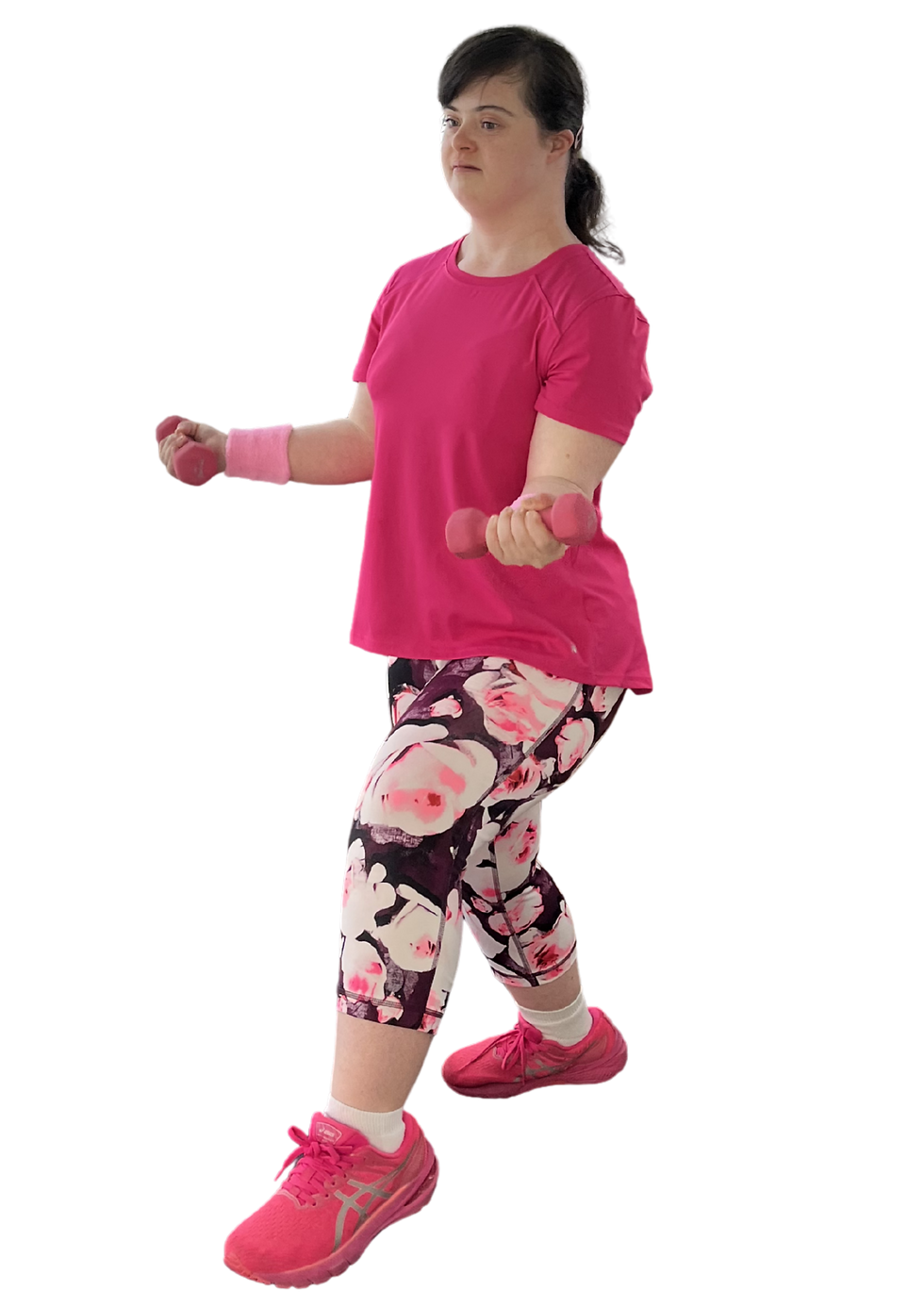
Our online fitness app features demonstration videos led by my 32-year-old daughter—who has Down syndrome herself. Every single exercise she demonstrates has been vetted against strict safety protocols.
Here is how we adapt our programming to keep your loved one 100% safe:
1. Absolute Zero "Axial Loading"
We never place heavy weights directly on top of the spine or shoulders. This means no traditional barbell back squats and no heavy overhead barbell presses, which can crush or compress the cervical vertebrae.
The T21 Safe Switch: We replace these with chest-loaded Dumbbell Goblet Squats, seated resistance band presses, or floor-based movements that keep the spine long, unloaded, and completely supported.
2. Elimination of Forced Neck Flexion/Extension
Traditional gym core workouts often cause people to tug on their heads or aggressively bend their necks. We have completely banned traditional head hold crunches, sit-ups, bicycle crunches, and neck bridges from our library.
The T21 Safe Switch: We train the core using Arm to knee crunches, stability-first movements like Planks, Deadbugs, and Bird-Dogs, where the neck remains in a perfectly neutral, straight line from start to finish.
3. Low-Impact, Controlled Movements
High-impact, jarring movements can violently shake the upper spine. Our programs strictly avoid forward rolls, somersaults, trampoline work, or burpees that require rapid, uncontrolled head movements.
The T21 Safe Switch: We prioritize controlled, functional power. We use step-ups, low-impact bodyweight patterns, and slow, intentional resistance training to build joint strength and improve balance without the shockwaves of high-impact landing.
Safety First, Fitness Always
By combining professional training methodologies with a deep, lived understanding of Trisomy 21, we have built a global platform where adults with additional needs can work out safely, build independence, and have fun doing it.
Before starting, we require all participants to have our custom Physician Sign-Off Form completed by their doctor to ensure their joint and cardiac health are fully cleared for success.
Comments